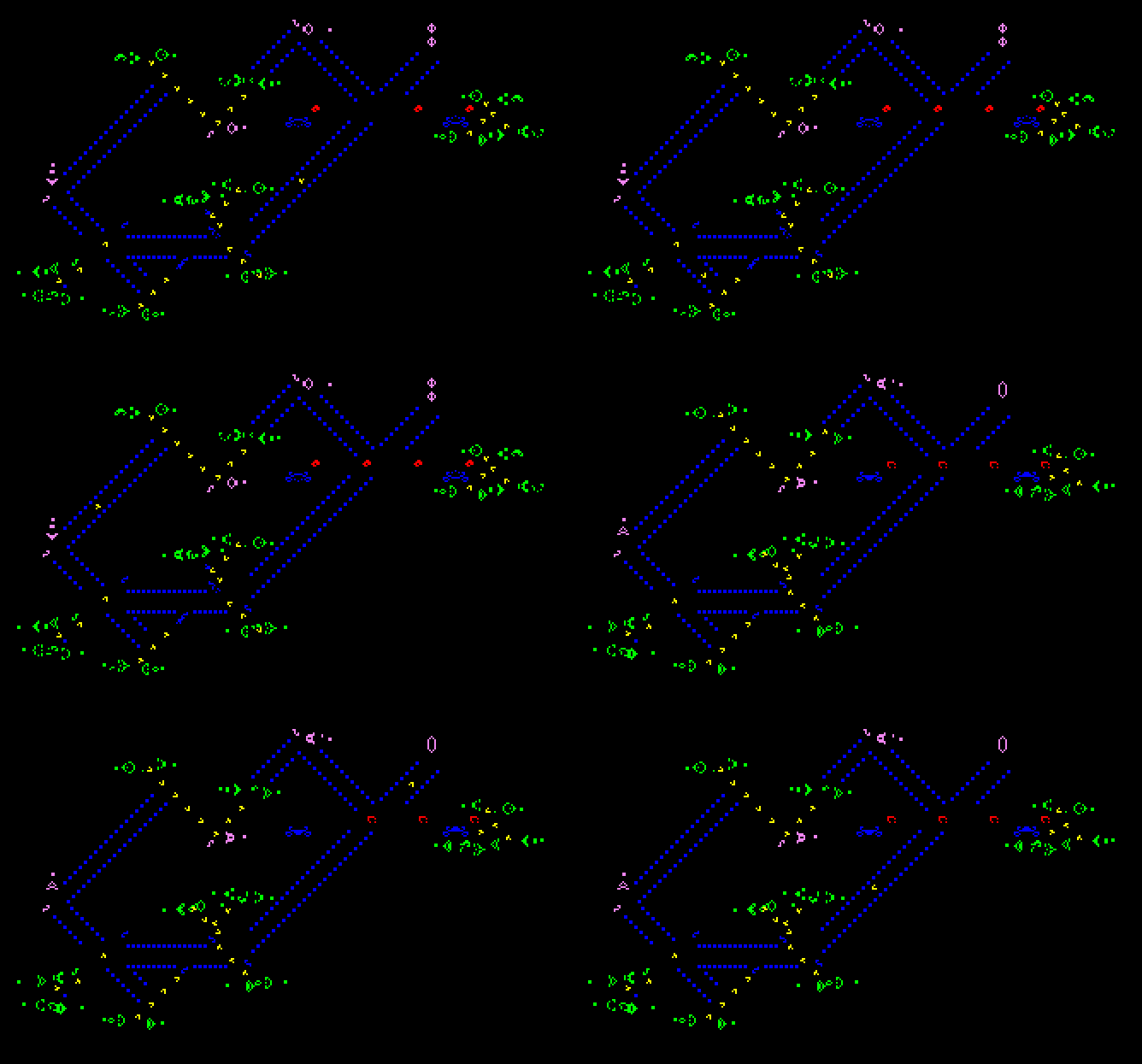
John Horton Conway a British mathematician was interested in a 1940s ploblem presented by John von Neumann, a Hungarian-American mathematicist and computist who attempted to find a hypothetical machine that could build copies of itself, so he started to work on it and although that machine haven't been done yet, he could find a mathematical representation.
This mathematical model was very complicated and Conway focused on the simplification of the model, his attempt of simplification was successful and was named The Game of Life. The game was published by first time in the October 1970 issue of Scientific American, in Martin Gardner's "Mathematical Games" column and it consists of the following:
The universe of the Game of Life is an infinite two-dimensional orthogonal grid of square cells, each of which is in one of two possible states, alive or dead. Every cell interacts with its eight neighbours, which are the cells that are horizontally, vertically, or diagonally adjacent. At each step in time, the following transitions occur:
- Any live cell with fewer than two live neighbours dies, as if caused by under-population.
- Any live cell with two or three live neighbours lives on to the next generation.
- Any live cell with more than three live neighbours dies, as if by overcrowding.
- Any dead cell with exactly three live neighbours becomes a live cell, as if by reproduction.
The initial pattern constitutes the seed of the system. The first generation is created by applying the above rules simultaneously to every cell in the seed—births and deaths occur simultaneously, and the discrete moment at which this happens is sometimes called a tick (in other words, each generation is a pure function of the preceding one). The rules continue to be applied repeatedly to create further generations.Since its creation the game has been of interest for scientists from many fields including physics, biology, biochemstry, mathematic, economy and computer science because of the surprising ways in which the patterns can evolve.
From http://en.wikipedia.org/wiki/Conway%27s_Game_of_Life
In computer science it is as so freaking interesting that anything that can be computed algorithmically can be computed within Life, this of course has influenced the culture around computing at the point that the hacker embleme is a representation of a glider formation in the game.
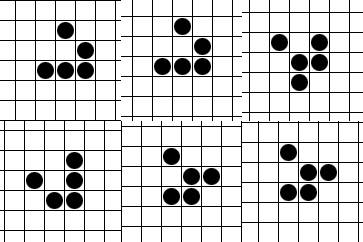 |
| The mutation and movement of a "glider". |
I think that after this intro you want to use it, so here are some Life programs that you can use in orther to know and discover more about this game. "Enjoy Life!"

No comments:
Post a Comment