By the moment I write this lines I've touched the owl's beak, I've been to the Crocodiles' Lagoon, to the Lonely Pine, I've been trolled by DACE and I've failed a subject, most of the things that might be named as part of what living the experience of studying in my uni means, but paradoxically tomorrow I'll face a new quarter that could fit perfectly in the syllabus of a humanist career but doesn't seem anything like Computer Engineering.
That's what happens when you failed (twice) the most important subject in the life of every uesebista: Maths I, the most elemental of all 7 Maths courses given in the USB but certainly the first door in our cebolla, where it all stars.
Due the fact that I* was* very* focused* on* the* subject* I've been out of the blogging stuff but now that I* should* have* more* time* I'll be able to publish more interesting stuff on my career despite the fact that I officially won't be seeing anything that implicates computers and science :'(.
And it's because of that "officially" that I stand before this new term considering it as a different chance of knowledge, growing and shit and not as a totally bad thing.
(*)1. Let's face it, the 99% of people doesn't fail classes for being focused. I am a person.
(*)2. Never underestimate subjects.
Sunday, April 22, 2012
Monday, December 12, 2011
A brief intro about hacking culture
Although the title of this web book sounds very wannabe, I consider this text by Eric Steven Raymond an excellent way to know more about hacking (more about the culture that the action itself), and it's an excellent guide to find start points in order to become one, don't hesitate in expending a little time at least to check:
Sunday, November 13, 2011
Friday, October 28, 2011
A couple of demonstrations of the sine and cosine of the addition of two angles
This is a problem that was send for us in MA1121, and although I haven't found my own way I've got two ways to demonstrate it that I found this early morning when I was studying for my quiz of today:
By similitude of triangles
Rotating the axes
Perhaps you were doing this, and now you feel spoiled, if that's the case then I let you another problem from Gaussianos.com that is really fod for thought:
By similitude of triangles
Rotating the axes
| Haciendo uso del hecho de que a cada punto del plano le corresponde un
vector y de
que los vectores se suman según la regla del paralelogramo, vamos a
demostrar las fórmulas para el seno y el coseno de la suma de dos
ángulos en función de los senos y cosenos de cada uno de ellos.
Concretamente vamos a demostrar las siguientes igualdades:
Rest of the explaination
at http://gaussianos.com/el-seno-y-el-coseno-de-la-suma-de-angulos/
|
Perhaps you were doing this, and now you feel spoiled, if that's the case then I let you another problem from Gaussianos.com that is really fod for thought:
Demonstrate that every triangle ABC that verifies that
is right angled.
Sunday, October 23, 2011
Life
It's been a long time since the last post and it is due to I have had to study a lot, but that has made me find several interesting things to post about, in this case about Math. There are many mathematics games and today I like to write about one of the most famous: The game of life.
John Horton Conway a British mathematician was interested in a 1940s ploblem presented by John von Neumann, a Hungarian-American mathematicist and computist who attempted to find a hypothetical machine that could build copies of itself, so he started to work on it and although that machine haven't been done yet, he could find a mathematical representation.
This mathematical model was very complicated and Conway focused on the simplification of the model, his attempt of simplification was successful and was named The Game of Life. The game was published by first time in the October 1970 issue of Scientific American, in Martin Gardner's "Mathematical Games" column and it consists of the following:
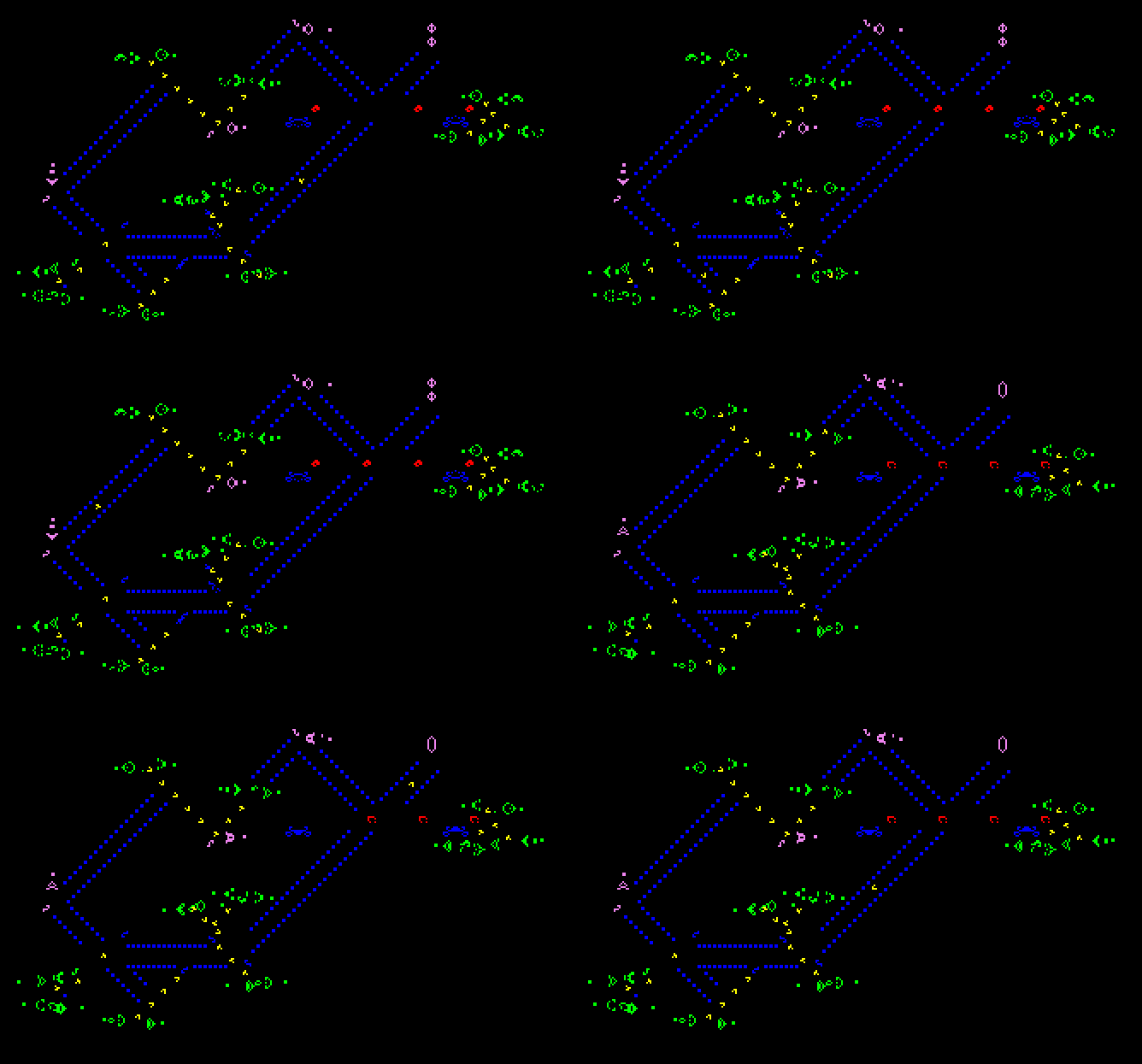
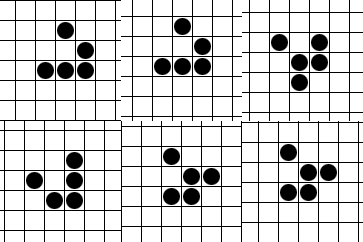
In computer science it is as so freaking interesting that anything that can be computed algorithmically can be computed within Life, this of course has influenced the culture around computing at the point that the hacker embleme is a representation of a glider formation in the game.
This particurlar formation has got the property of being a spaceship and they travel diagonally across the board, but this is not the only you can do with gliders. Among the things that you can build from gliders are counters, logic gates and one may also build a pattern that acts like a finite state machine connected to two counters. This has the same computational power as a universal Turing machine, so, using the glider, the Game of Life is theoretically as powerful as any computer with unlimited memory and no time constraints: it is Turing complete.
I think that after this intro you want to use it, so here are some Life programs that you can use in orther to know and discover more about this game. "Enjoy Life!"
John Horton Conway a British mathematician was interested in a 1940s ploblem presented by John von Neumann, a Hungarian-American mathematicist and computist who attempted to find a hypothetical machine that could build copies of itself, so he started to work on it and although that machine haven't been done yet, he could find a mathematical representation.
This mathematical model was very complicated and Conway focused on the simplification of the model, his attempt of simplification was successful and was named The Game of Life. The game was published by first time in the October 1970 issue of Scientific American, in Martin Gardner's "Mathematical Games" column and it consists of the following:
The universe of the Game of Life is an infinite two-dimensional orthogonal grid of square cells, each of which is in one of two possible states, alive or dead. Every cell interacts with its eight neighbours, which are the cells that are horizontally, vertically, or diagonally adjacent. At each step in time, the following transitions occur:
- Any live cell with fewer than two live neighbours dies, as if caused by under-population.
- Any live cell with two or three live neighbours lives on to the next generation.
- Any live cell with more than three live neighbours dies, as if by overcrowding.
- Any dead cell with exactly three live neighbours becomes a live cell, as if by reproduction.
The initial pattern constitutes the seed of the system. The first generation is created by applying the above rules simultaneously to every cell in the seed—births and deaths occur simultaneously, and the discrete moment at which this happens is sometimes called a tick (in other words, each generation is a pure function of the preceding one). The rules continue to be applied repeatedly to create further generations.Since its creation the game has been of interest for scientists from many fields including physics, biology, biochemstry, mathematic, economy and computer science because of the surprising ways in which the patterns can evolve.
From http://en.wikipedia.org/wiki/Conway%27s_Game_of_Life
In computer science it is as so freaking interesting that anything that can be computed algorithmically can be computed within Life, this of course has influenced the culture around computing at the point that the hacker embleme is a representation of a glider formation in the game.
| The mutation and movement of a "glider". |
I think that after this intro you want to use it, so here are some Life programs that you can use in orther to know and discover more about this game. "Enjoy Life!"
Wednesday, October 19, 2011
Thursday, October 13, 2011
Mehr um Deutsch zu lernen
Warnung: this post ist written in Denglisch, I do not like doing it like this either but I'm in level A1 ;)
Following my course learning Deutsch, I've found a couple more tools to work mit, ein für learn more Deutsch und another für practicing:
Aprendealeman.com. Its title is very explicit so I don't have to explain much about this site but I highlight that unlike other sites this offers the audios with pronunciation of the words and with an "understandablecaptable" speed. Apart from this the site also offers tongue-twisters -very useful for pronunciation- and things about Deutsch Kultur, for those who -like me- use the Sprahen to know more about the people who uses it.
Schubert-verlag.de. This site is in Deutsch, it offers exercises of all levels of Deutsch according to the programme levels (A1, A2, B1 ...).
This is alle for now und if you found any mistake in mein bisschen Deutsch bitte let me know it! :)
Subscribe to:
Posts (Atom)